Board components are the user interface elements that you add to a board. In DesignStudio, components appear in Design mode, on the Components tray.
In Design mode, you design the board and drag components to the canvas. For information about available components, their settings, and their toolbars, see Board Components List.
There are two sets of components available.
-
Classic Styling: All components from DesignStudio 2.5 and previous are included and function the same as they did in previous versions.
-
Nexus Component Styling: All classic components have been rebuilt, with additional settings, styles, and display options. Components have also been added. Additionally, when you configure a Nexus Component Styling component, updates are reflected on the canvas in real time. Unlike Classic Styling components, you do not need to save your changes to see the updates.
The type of component you use is determined as you create a board view based on whether you select the Use Nexus Component Styling checkbox.
All boards built with Classic Styling components still function as expected. There is no need to rebuild boards using new components.
Different views in the same board can use either type of component. In other words, you can use the Nexus Component Styling on an Input view and the Classic Styling on a List view while building the same board.
If you generate a Details view from an Input view, that Details view will automatically use the same components as the Input view. In other words, you will not have the option to select the type of components when you generate a Details view from an input view.
To add components to a board using the Nexus Component Styling
-
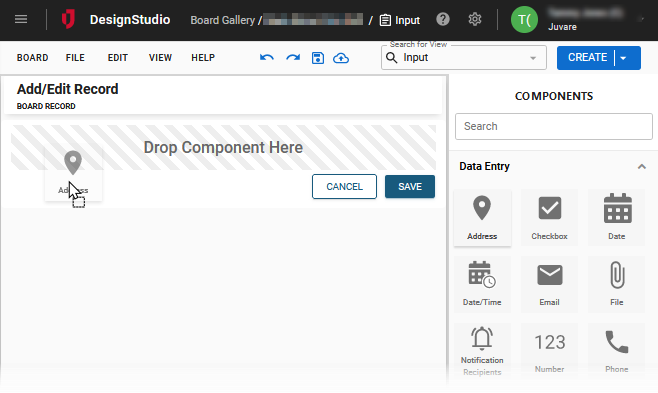
With your board open on the Board Workspace, drag the components onto the canvas. You can have up to four components side-by-side. In the following example, the Address component is dropped.
-
In the Properties tab, under Settings, enter the setting information. The component updates in real time to reflect your updates.
For details about the settings, see Board Components List.
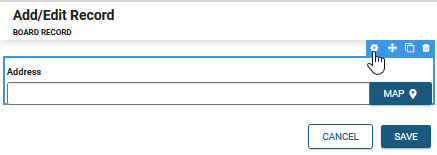
To return to the component's Properties tab to make additional updates, click the component on the canvas, and then click the settings icon on the top right of the component.
-
Repeat steps 1 and 2 to add additional components until your board design is complete. As you drag the component over the canvas, a green line indicates where the component will be inserted.
-
Above the canvas, in the top right, click Save.
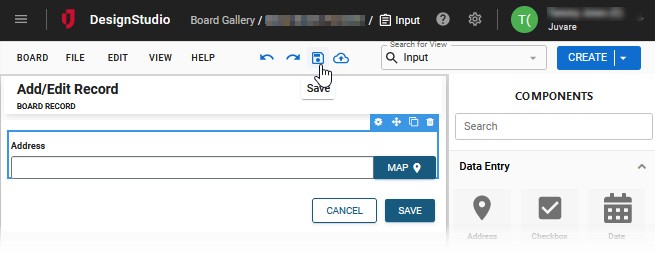
The Cancel and Save buttons that appear at the bottom of the canvas are for display only. They provide a visualization of what the buttons will look like on the WebEOC board. They do not save any work in DesignStudio.
To add components to a board when using Classic Styling
-
With your board open on the Board Workspace, drag the components onto the canvas. You can have up to four components side-by-side in the form. In the following example, the Address component is dropped.
-
In the settings window that appears, on the Settings tab, enter the setting information, and then click Done. For details about the settings, see Board Components List.
if you need to return back to this window, click the component on the canvas, and then click the settings icon on the top right of the component.
-
Repeat steps 1 and 2 to add additional components until your board design is complete. As you drag the component over the canvas, a green line indicates where the component will be inserted.
-
Above the canvas, click Save.
The Cancel and Save buttons that appear on the canvas at the bottom of the board are for display only. They provide a visualization of what the buttons will look like on the WebEOC board. They do not save any work in DesignStudio.
Related Concepts
Related Tasks
Create a Board Using the Board Wizard
Preview Boards on Multiple Devices
Preview Boards in Light and Dark Modes
View History and Restore Versions
Reference Materials