Archive, Restore, and Delete Groups
Groups include organizational groups A cluster of positions that, with process permissions, defines the structure for process flow. and feature groups.
As an administrator, you can archive, restore, or permanently delete groups. Archiving and restoring groups provides a safer alternative to deleting them. Archiving allows groups to retain history and to be restored, along with their previous assignments, if needed.
Your WebEOC Nexus configuration likely uses two types of groups, organizational groups and feature groups, to allow users, through positions, to access features and workflows, and to control the access level to data along the way. If you archive or delete a group, ensure that any positions in that group are assigned to another group with the correct permissions before archiving or deleting the group.
Archiving, restoring, and deleting are all tracked as events in the audit log Tracks and records administrative events that occur in WebEOC Nexus; supports monitoring and assessment of administrator/user activities; aids in troubleshooting..
As a recommended approach:
-
Archive a group instead of deleting it to keep the group history and assignments recoverable.
-
Review archived groups regularly to maintain clean records.
When a group is archived, the group is:
-
Unassigned from all positions.
-
Unassigned from all features, like boards, plug-ins, or maps.
-
No longer visible in the platform or on reports.
-
Not selectable as board-notification recipients or scheduled-notification recipients. The recipient pickers for each of these notification types do not include archived groups.
-
Displayed on the Archived Groups page.
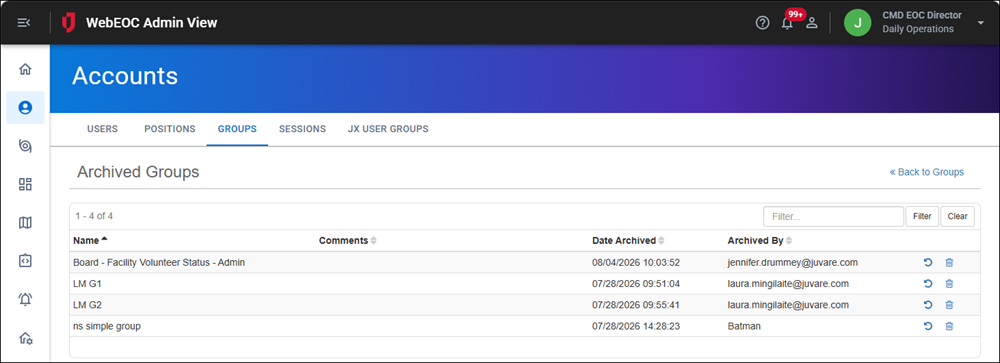
When a group is restored, the group is:
-
Assigned to previous positions.
-
Assigned to previous features, like boards, plug-ins, or maps.
-
Available as board-notification recipients or scheduled-notification recipients.
-
Displayed on the Groups tab.
To perform the steps on the Archived Groups page, you must be either:
-
An Account Type of Full Administrator
An account type with access to all features and functions in the Admin View.. Users of this type can archive and restore any group.
-
A Partial administrator
An account type with access to a configurable subset of administrative features, set via an admin profile. of an Admin Profile A tool that lets full admins configure and assign permissions to specific users who have a Partial Administrator account type. that has the Groups Admin Manager assigned with the Delete permission enabled. See Admin Profiles for details.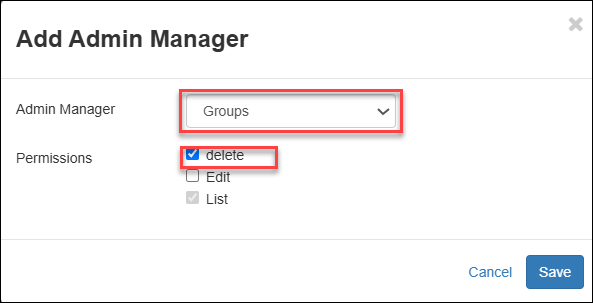
Archive a Group
See the introduction to this page for the changes that occur when a group is archived.
To archive a group
- Access the Admin View.
-
In the main menu, click the accounts icon
 . The Accounts page opens.
 -
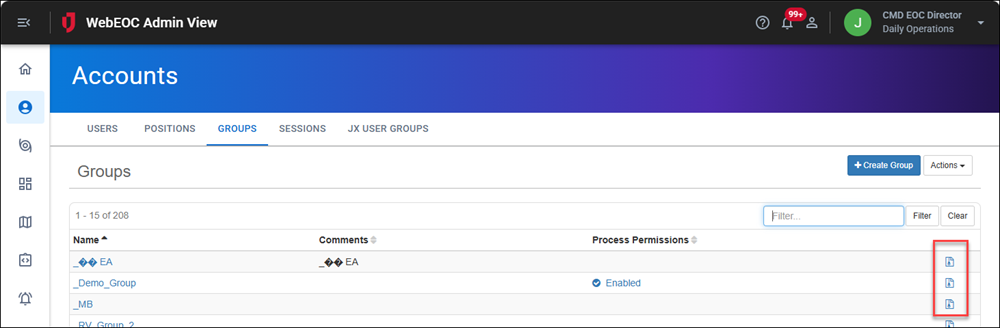
On the Groups tab, on the right of the group to be archived, click the Archive icon.
-
Click OK to the confirmation message.
Restore an Archived Group
After a group has been archived, it can be restored. See the introduction to this page for all of the changes that occur when a group is restored.
To restore an archived group
- Access the Admin View.
-
In the main menu, click the accounts icon
. The Accounts page opens.
-
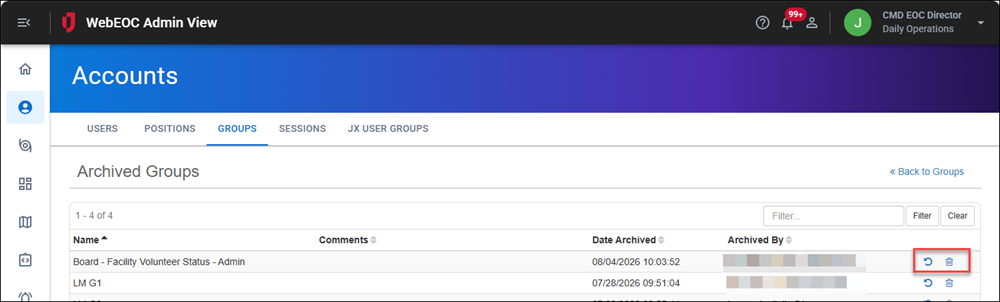
On the Groups tab, click the Actions button and select Archived Groups.
-
For the group to be restored, click the Restore icon to the left of the Delete icon.
-
Click OK to the confirmation message.
Delete a Group
After a group has been archived, you can permanently delete it.
As a recommended approach, permanently delete a group only when compliance or policy requires full removal.
Deleting a group permanently removes it from WebEOC Nexus. This action cannot be undone.
To delete an archived group
- Access the Admin View.
-
In the main menu, click the accounts icon
. The Accounts page opens.
-
On the Groups tab, click the Actions button and select Archived Groups.
-
For the group to be deleted, click the Delete icon on the far right.
-
Click OK to the confirmation message.